Basilica Cistern’s Seismic Resilience: Surviving 22 Earthquakes
Why the Basilica Cistern withstood centuries of earthquakes — design features, materials, and smart maintenance.
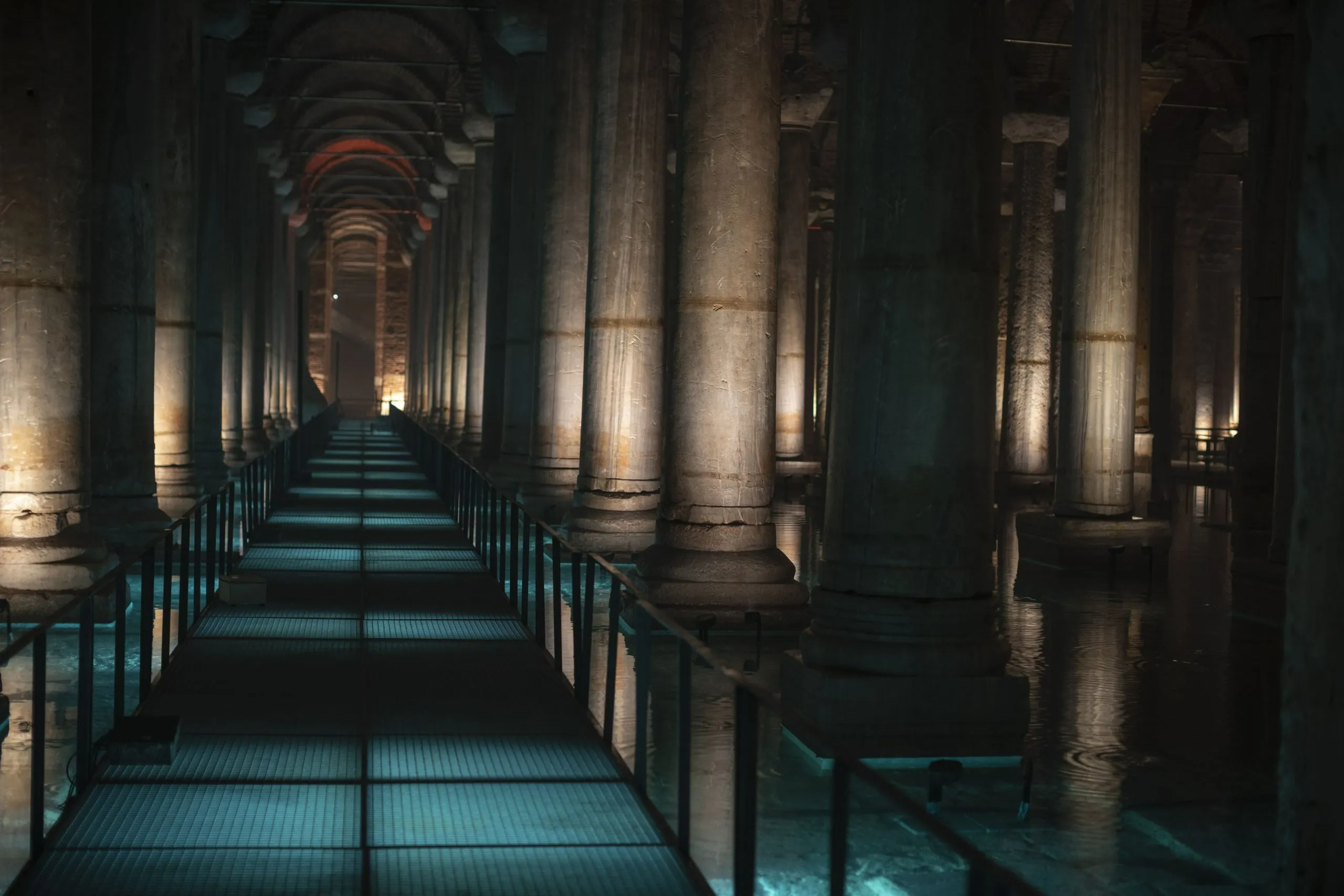
Quick take: The Basilica Cistern has endured roughly 22 significant earthquakes thanks to redundant load paths, flexible lime mortar, and a column-grid + arch system that dissipates seismic stress.
Overview
- Built in the 6th century under Justinian I, the cistern spans ~10,000 m² and stores up to 80,000 m³ of water.
- Its 336-column grid and brick vaults form a naturally ductile structure suited to tremors.
- Today it stands as a living case study in long-term resilience and adaptive conservation.
Seismic Design, 6th-Century Style
- Grid distribution: loads spread across many columns, minimizing single-point failure.
- Arches + vaults: self-bracing geometry funnels forces to supports.
- Lime-based mortar: slight elasticity absorbs micro-movements better than brittle mixes.
- Mass damping: water volume can dampen high-frequency vibrations.
Mental model: arches behave like force funnels; when shaken, they guide loads into many columns rather than a few brittle points.
Timeline of Shocks & Repairs
- Quakes across Byzantine, Ottoman, and modern eras prompted periodic repairs.
- 1987 public opening led to improved platforms and non-invasive reinforcements.
- Recent updates: lighting, drainage, and walkway stabilization without altering original thrust lines.
Engineering Details
- Column bases sit on compacted subgrade with lime bedding.
- Vault bricks laid in ring courses, spreading thrust evenly.
- Waterproof plasters reduce water ingress → material decay cycles.
Visiting Tips (Safety + Comfort)
- Off-peak hours = calmer ambience; bring a light layer for cool, damp air.
- Watch footing on wet platforms; follow lane flow.
- Photography: brace on railings, use ISO 800–1600; tripods often restricted.
Fast Facts
- Built under Justinian I (6th century).
- Footprint ~9,800–10,000 m².
- Capacity ~80,000 m³.
- Columns 336; aisles ~4–5 m spacing.
FAQ
- Is the cistern safe during quakes?
- It has proven resilient; modern safety measures complement historic design.
- Can water help stability?
- Large masses can dampen vibration; managers control levels.

Bottom Line
Byzantine builders engineered a forgiving structure: many columns, elastic joints, and water-buffered vaults — yielding remarkable seismic resilience still felt today.
Sobre o autor

Istanbul Planner
Criei isto para o ajudar a encontrar a Cisterna da Basílica com calma, contexto e cuidado — para que tijolo, água e tempo falem claramente na meia‑luz.
Tags
Comments (0)
Loading comments...